
Research

My research deals with cognitive psychology of second language acquisition, relating to psychological mechanisms of how people acquire a second language (L2) and how the knowledge about the process and mechanism of learning can be applied to classroom instruction. I place the premium on practice, defined as “specific activities in the second language, engaged in systematically, deliberately, with the goals of developing knowledge of and skills in the second language” (DeKeyser, 2007, p.1).

Every time I ask during my classes or talks whether practice is necessary for L2 learning, everyone raises their hand. But when I ask whether anyone has ever wanted to research that question or investigate it more deeply, no one raises their hand. Why?

In my lab, we ask a wide range of questions revolving around the concept of practice in L2 learning. Here are just a few examples:
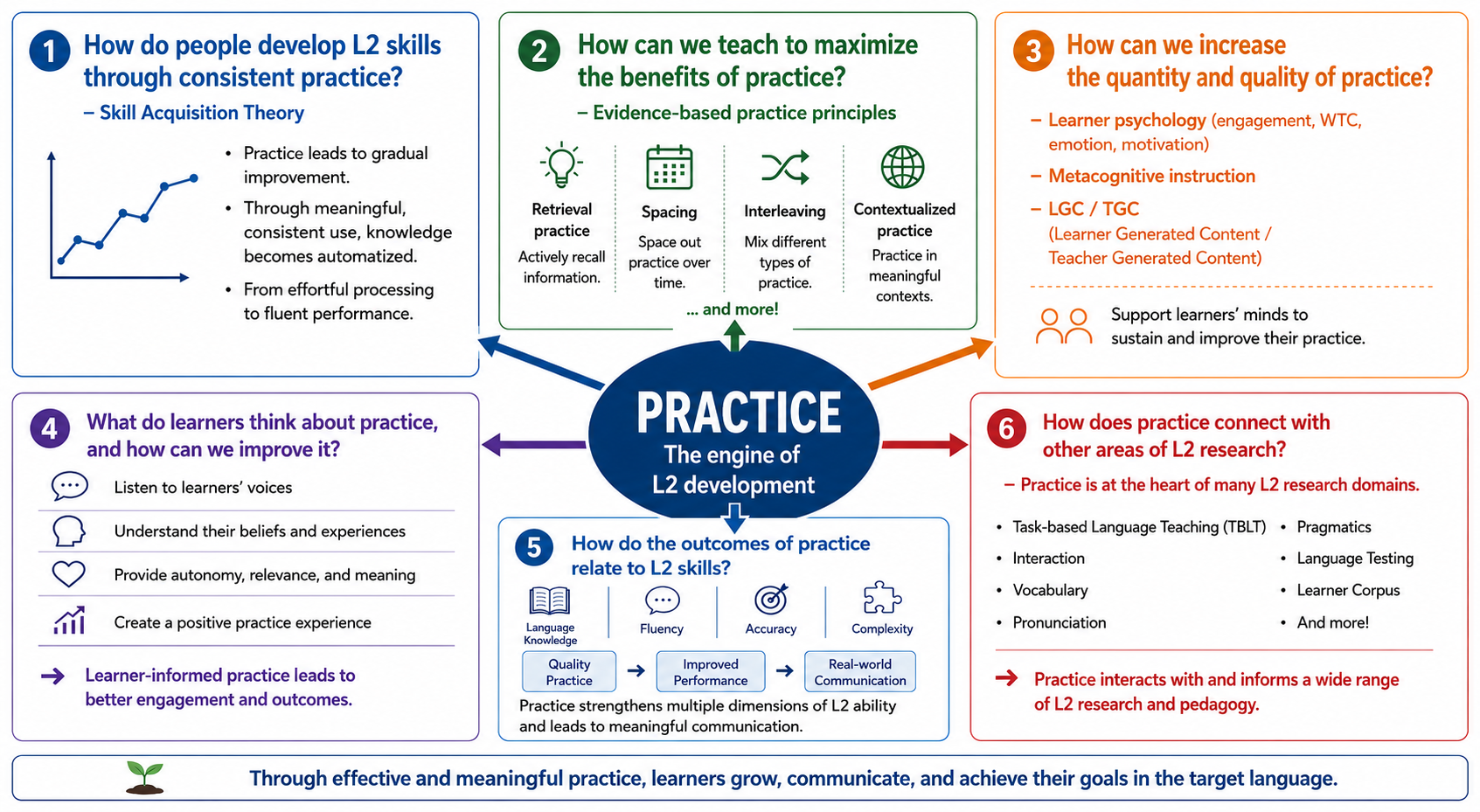


Skill Acquisition Theory

I subscribe to a theoretical approach conceptualizing L2 learning as a form of skill acquisition. Skill Acquisition Theory equates L2 learning and (general) skill acquisition in terms of learning processes (the underlying mechanisms) and products (how knowledge and performance develops such as accuracy and speed). The original conception of Skill Acquisition Theory (as applied to L2 learning) was formulated by Robert DeKeyser (e.g., DeKeyser, 1997), and my primary research tasks are to further develop, specify, and test the theory vis-à-vis L2 learning. In doing so, I draw on the existing models of (cognitive) skill acquisition (such as ACT-R, Instance Theory, CMPL-theory, etc.) as well as models of language learning, processing, and use (especially those from psycholinguistics) and (hope to) formulate models of L2 skill acquisition under Skill Acquisiton Theory.

Relevant work:

Roles of Practice in L2 Learning and Teaching

In development.

Relevant work: